#6 · Duke
Valefor
The 6th of the seventy-two, a duke. A good familiar - but tempts those who trust it to theft. In the language of this path, Valefor is a shadow pole — worked only with its angel, Lelahel.
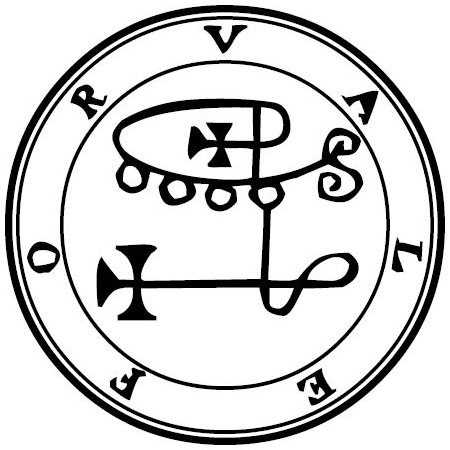
| Rank | Duke |
| Number | 6 of the 72 |
| Legions | 10 |
| Direction | West in most modern occult correspondence tables, but genuinely unsettled — the primary grimoires assign Valefor no cardinal point, and other modern sources give North or South. Treat as a modern, disputed attribution rather than a grimoire fact. |
| Also called | Valefor · Valefar · Valafar · Malaphar · Malephar · Valu |
| Angel (light pole) | Lelahel — Shem #6 |
What the grimoires say
In the 1904 Goetia, Valefor is a Duke governing 10 legions. A good familiar — but tempts those who trust it to theft.
Appears as a lion bearing the head of a donkey (an ass) and bellowing; some manuscript traditions instead give him the head of a thief.
“The Sixth Spirit is Valefor. He is a mighty Duke, and appeareth in the shape of a Lion with an Ass's Head, bellowing. He is a good Familiar, but tempteth them he is a familiar of to steal. He governeth 10 Legions of Spirits. His Seal is this, which is to be worn, whether thou wilt have him for a Familiar, or not.”— Mathers & Crowley, The Goetia (1904), public domain
The shadow it carries
Stripped to the bone, Valefor's traditional office turns on reputation as a dependable or 'good' familiar spirit — a long-term working relationship rather than a one-off summoning. Read plainly, that is a real human force; in the language of this path its raw, unowned form is a shadow pole. Its shadow is what that force does when it runs you from the dark; its gold is the same force — seen, owned, governed.
You never reach for it alone. Its light pole is the angel Lelahel; met together, behind protection, Valefor becomes a disowned part of yourself approached while the light is already in the room.
Correspondences
A word of honesty first: almost none of the table below is from the old grimoires. The rank, legions, direction and office are traditional; the planet, day, colour, tarot, incense and the Enn are modern attributions (mostly 20th–21st-century Demonolatry and correspondence compilations), and the sources openly disagree. Use them as a working frame, not as law.
| Correspondence | Value | Where it comes from |
|---|---|---|
| Animal | Lion; donkey/ass (and, in the thief-headed variant, no beast) | Derived directly from the grimoire appearance description; not an external correspondence. |
| Tarot | Seven of Pentacles (Golden Dawn decan system); Four of Wands in the Rudd/Shem-angel scheme | Modern (post-1900) Golden Dawn decan attributions; not in the primary grimoires. |
| Zodiac / decan | Taurus 20–30° (3rd decan) in the Golden Dawn Goetia; alternatively Aries 25–30° via the paired Shem angel Lelahel (Rudd) | Modern occult attribution; the two competing schemes disagree. |
| Date-window | c. 11–20 May (Golden Dawn Taurus decan); alternatively c. 15–19 April (Aries decan of the Shem angel Lelahel) | Modern occult attribution, derived from the decan schemes above; disputed. |
| Planet | Venus | Modern occult correspondence (via Duke-rank / Friday associations); no planet is assigned in the grimoires, and the Golden Dawn decan ruler would differ. |
| Day | Friday | Modern occult correspondence, following the Venus attribution. |
| Element | Earth (modern Demonolatry Enn lists); Water or Air in some Golden Dawn-derived tables | Modern; sources conflict. |
| Metal | Copper | Modern occult correspondence, following the Venus attribution. |
| Candle colour | Green | Modern occult correspondence, following the Venus attribution. |
| Incense | Sandalwood | Modern occult correspondence; not a grimoire datum. |
| Plant | No traditional attribution; modern lists tend to borrow Venusian herbs (e.g. rose, vervain) | Modern inference; flagged as not fixed in any source. |
Its modern Enn — a chant from the Demonolatry current, not found in any grimoire:
“Keyman vefa tasa Valefor — MODERN: a Demonolatry chant popularised in late-20th/early-21st-century texts”
Making a connection
Gathered from what practitioners report, put plainly — a starting point, not a rule:
- Sit with the seal above as the first meeting-place: trace it, hold it in the mind’s eye, and let impressions arrive without grabbing at them.
- Set a gentle frame. Keep it simple — a green candle, a friday, a little incense, a moment of quiet. If you work the Demonolatry current, chant the Enn softly — more like settling than commanding.
- Bring the real theme. Practitioners associate Valefor with loyalty, trust, and the testing of trust between practitioner and spirit, associations with theft, taking, and the acquisition or recovery of objects (the grimoire's 'tempteth to steal' motif). Name what you actually want, and ask — don’t demand.
- Journal before and after, and treat everything as your own experience, not fixed doctrine.
Rank, legions, direction and office are from the public-domain grimoires (Weyer 1577; Mathers & Crowley, The Goetia, 1904). Images are public domain: the 1904 seal. The Enn and the planet/day/colour/tarot correspondences are modern attributions (Demonolatry and compilations), flagged as such; sources disagree, and no copyrighted description or artwork is reproduced. Angel pairing per the Rudd tradition. Take the technique, never the tribe.
“A loyal thief is still a thief. Watch what you let grow familiar.”