#67 · Duke
Amdusias
The 67th of the seventy-two, a duke. Gives concerts (music heard, players unseen). In the language of this path, Amdusias is a shadow pole — worked only with its angel, Eyael.
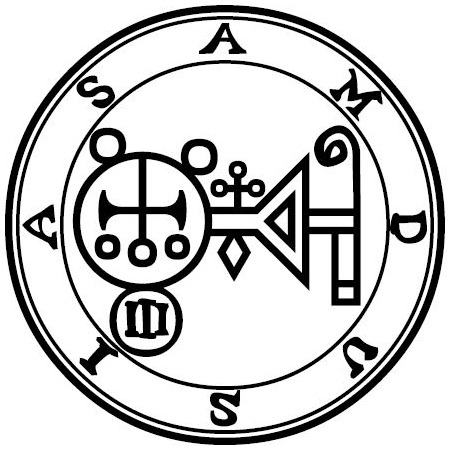
| Rank | Duke |
| Number | 67 of the 72 |
| Legions | 29 |
| Direction | South (traditional Goetia rank-attribution: Dukes are classed under the South wind); some modern decan-based systems instead cite Southeast |
| Also called | Amdusias · Amduscias · Amdukias · Ambduscias · Amducias · Amducious |
| Angel (light pole) | Eyael — Shem #67 |
What the grimoires say
In the 1904 Goetia, Amdusias is a Duke governing 29 legions. Gives concerts (music heard, players unseen); bends trees; gives familiars.
A great and strong duke who first shows himself in the form of a unicorn and, when asked, takes human shape; his coming is heralded by the sound of trumpets and other musical instruments, and he can make trees bend at the operator's will.
“The Sixty-seventh Spirit is Amdusias, or Amdukias. He is a Duke Great and Strong, appearing at first like a Unicorn, but at the request of the Exorcist he standeth before him in Human Shape, causing Trumpets, and all manner of Musical Instruments to be heard, but not soon or immediately. Also he can cause Trees to bend and incline according to the Exorcist's Will. He giveth Excellent Familiars. He governeth 29 Legions of Spirits. And his Seal is this, etc.”— Mathers & Crowley, The Goetia (1904), public domain
The shadow it carries
Stripped to the bone, Amdusias's traditional office turns on music, sound and the voice — the figure is defined in the grimoires by trumpets and musical instruments. Read plainly, that is a real human force; in the language of this path its raw, unowned form is a shadow pole. Its shadow is what that force does when it runs you from the dark; its gold is the same force — seen, owned, governed.
You never reach for it alone. Its light pole is the angel Eyael; met together, behind protection, Amdusias becomes a disowned part of yourself approached while the light is already in the room.
Correspondences
A word of honesty first: almost none of the table below is from the old grimoires. The rank, legions, direction and office are traditional; the planet, day, colour, tarot, incense and the Enn are modern attributions (mostly 20th–21st-century Demonolatry and correspondence compilations), and the sources openly disagree. Use them as a working frame, not as law.
| Correspondence | Value | Where it comes from |
|---|---|---|
| Traditional form / animal | Unicorn (then human shape); later lore adds a trumpet and clawed hands/feet | Traditional — 1904 Goetia and de Plancy 1863 (unicorn form, trees bow, 29 legions) |
| Tarot | 8 of Cups; 5 of Swords | Modern — idiosyncratic personal correspondence system (V.K. Jehannum); no historical basis |
| Zodiac / decan | c. 0–10° Aquarius (also given as 0–5° Pisces) | Modern — reconstructed decan-to-Goetia mappings; disputed and system-dependent. Note: the paired Shem angel Eyael/Eiael (#67) is traditionally tied to roughly 0–5° Pisces |
| Planet | Venus / Mars (Neptune in some modern lists) | Modern — planetary attributions are 20th–21st-c. syncretic additions, not in the grimoires |
| Day | Not traditionally assigned; modern practice keys to the chosen planet (e.g. Friday for Venus, Tuesday for Mars) | Modern — inferred from planetary correspondence; no historical source |
| Element | Air (voice/music); Earth in some lists | Modern — thematic association with sound and thunder; not in the grimoires |
| Metal | Copper (Venus) / Silver | Modern — derived from the modern planetary attribution |
| Candle colour | Practice varies; commonly cited green, orange or light blue | Modern — contemporary practitioner convention only |
| Incense | Sandalwood, cinnamon (also frankincense/mimosa in some lists) | Modern — contemporary practitioner convention; no historical source |
| Plant / herb | Mimosa, hibiscus, ginger, cinnamon (varies by author) | Modern — idiosyncratic correspondence lists (e.g. Jehannum); not traditional |
| Animal | Unicorn (from the grimoire form); bird in some modern lists | Unicorn is traditional (1904 Goetia); bird is a modern addition |
| Date-window | ~19–23 February (Pisces 0–5°); some modern demon-decan lists instead give ~20–29 January (Aquarius) | Feb window derives from the Shem angel Eyael's traditional calendar days; the January window is a modern demon-decan assignment. Both are reconstructions, not from the Goetia itself |
Its modern Enn — a chant from the Demonolatry current, not found in any grimoire:
“Denyen valocur avage secore Amdusias”
Making a connection
Gathered from what practitioners report, put plainly — a starting point, not a rule:
- Sit with the seal above as the first meeting-place: trace it, hold it in the mind’s eye, and let impressions arrive without grabbing at them.
- Set a gentle frame. Keep it simple — a practice varies; commonly cited green, orange or light blue candle, a not traditionally assigned; modern practice keys to the chosen planet, a little incense, a moment of quiet. If you work the Demonolatry current, chant the Enn softly — more like settling than commanding.
- Bring the real theme. Practitioners associate Amdusias with command over the natural world, especially trees bending at will (later folklore extends this to storms and thunder), obtaining and working with familiar spirits ('giveth excellent familiars'). Name what you actually want, and ask — don’t demand.
- Journal before and after, and treat everything as your own experience, not fixed doctrine.
Rank, legions, direction and office are from the public-domain grimoires (Weyer 1577; Mathers & Crowley, The Goetia, 1904). Images are public domain: the 1904 seal. The Enn and the planet/day/colour/tarot correspondences are modern attributions (Demonolatry and compilations), flagged as such; sources disagree, and no copyrighted description or artwork is reproduced. Angel pairing per the Rudd tradition. Take the technique, never the tribe.
“The music is real even when you cannot see the players. Trust the ear.”